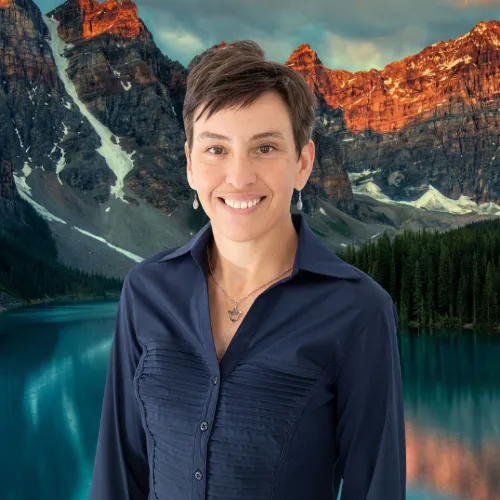


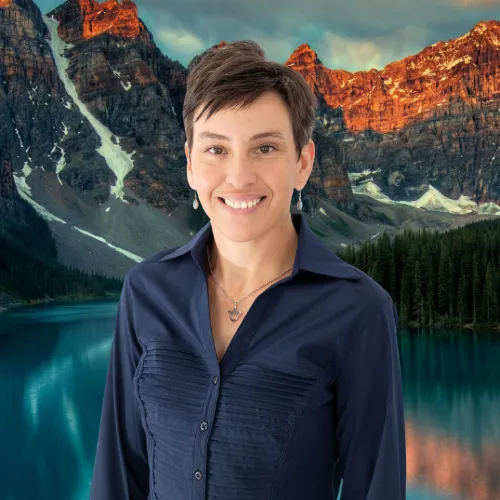

Meet Nancy Loedy
I would like to be remembered as someone who deeply cared — who helped you heal in ways you didn't imagine possible.— Nancy Loedy
A Seeker, Before She Was a Teacher

Nancy's path into this work was not strategic. It was survival. She was living with migraines, brain fog, chronic pain, a cluster of allergies, and the aftermath of a concussion. She had tried what most people try. Nothing held.
Yoga brought her next door to a healing center, where a sign in the window asked a question she had not allowed herself to answer out loud: do you want to feel better? She walked in and said yes. Chiropractic care came first, then nutritional realignment under Dr. Ann Doggett, and then — almost incidentally — a Brain Integration session with a practitioner she had just met. A five-minute protocol cleared a lifelong cat allergy. A five-minute protocol changed the course of her life.
She flew to Colorado to train directly under Susan McCrossin, the originator of Crossinology® Brain Integration Technique. That was 2011. Fourteen years later, she is a certified practitioner, a Crossinology® Master Teacher and Mentor, a member of the Board of Education, and a full-time steward of this work. She has guided thousands of clients — from newborns to people in their eighties — through sessions that look quiet from the outside and feel unmistakable from the inside.
The Principles That Guide Her Work
Presence is the First Protocol
Nancy believes every person wants to be heard and understood. Her sessions begin with attention — full, uninterrupted, unhurried. The technique does not work around the person. It works because of the person.
Gatebreaking Over Gatekeeping
She teaches to dismantle the barriers that keep skilled practitioners waiting in the wings. Her students get the real techniques in the shortest time possible, with the mentorship to use them well.
Integrity
The work does not need hype. Nancy's practice rests on measurable outcomes, careful observation, and the quiet authority of a method that actually delivers, session after session, year after year.
Empowerment Over Dependence
Her goal is never to make clients reliant on her. It is to give them — and the practitioners she trains — the tools, the confidence, and the permission to do this work for themselves and for others.
Respect for Individual Worth
She meets each person where they are. Not where she thinks they should be, not where a protocol says they are, but where they actually are. Dignity is not a step in the method. It is the method.
Wellness as a Foundation, Not a Reward
Nancy came to this work through her own body's distress. That experience anchors how she holds space for others: self-care is not something you earn once the hard work is done. It is the ground the work is done on.
What It's Like to Work with Nancy
Many of her clients arrive as a last resort. They have seen multiple practitioners. They have been told, gently or not, that it is all in their head. They arrive carrying the weight of not being believed.
She Listens First
Before any protocol, there is a conversation. Nancy listens for what has not worked, what has been dismissed, what the body has been trying to say. She is looking for the pattern, not the symptom.
She Works With the Body's Intelligence
Brain Integration uses muscle testing to let the body speak directly. This is not guesswork layered over intuition. It is a structured dialogue with the system itself — precise, repeatable, and remarkably honest.
She Moves Efficiently
Clients have told her she works more quickly than other practitioners, completing corrections with fewer passes. That is not a shortcut. It is the accumulated precision of fourteen years of practice and thousands of sessions.
She Meets a Broad Range of Challenges
Her clients have included people living with specific learning difficulties (ADD, ADHD, dyslexia), anxiety, depression, chronic pain, allergies, sensory processing challenges, emotional stuckness, and the quiet fatigue of lives that have felt harder than they should be.
She Doesn't Promise What She Can't Deliver
Nancy does not sell miracles. She offers a technique with a clear mechanism, a track record, and honest conversation about what it can and cannot do. Her clients return because the work holds.
A Mission Born from What She Could Not Fix
Nancy lost both of her parents to cancer. She watched people she loved suffer without answers. And during her own hardest seasons, she could not find the help she needed either.
That sense of helplessness stayed with her — until Brain Integration gave her something different. Something that worked. Something real, lasting, and transformative.
Now her work is singular in focus: to be the bridge that carries this technique from its origin to the people who need it — and to empower the practitioners who will carry it further than she can reach alone. This is not a business she built. It is a promise she is keeping.
What She Is Building Quietly, Over Time
When Nancy speaks about success, she does not talk about revenue or reach. She talks about what happens after she is no longer the one teaching. She talks about Crossinology® continuing through passionate and empowered teachers. She talks about a growing, global community of skilled practitioners. She talks about something she has not yet built but believes in completely:
A non-profit arm of this work. Sessions offered at no cost to the communities who need them most. The outcome of a person's life — changed, because someone believed the technique belonged to them too.
That is the legacy she is quietly building. Not a brand. A transfer of capability, from one trained hand to another, outward, until this work is no longer rare.
What Nancy Says About the Work
Most of my clients come to me at the end of their rope. They've seen multiple practitioners who often tell them it's all in their head. Deep down, they know a better life is possible — they just don't know how to get there.
On Who Finds HerThis unique form of kinesiology is different. It actually helps people in ways that are real, lasting, and transformative.
On the TechniqueI believe each person wants to be heard and understood. So I take the time to be one hundred percent present and invested with my clients and my students.
On PresenceWhen we have something that works, we don't just change lives — we create a ripple effect of healing.
On Ripple EffectMy mission is to be the bridge — the cog in the wheel — that carries Brain Integration from Susan McCrossin to the people who need it most.
On MissionYou can help others today using this technique.
The Core MessageIf Any of This Resonates
The best way to understand what Nancy does is to read what her clients have written. The second best way is to begin a conversation.